Tuesday, April 10, 2012

Who You Gonna Believe?

Bookmark and Share By Helen Vollmer, President

Do you buy into what the president says or not?  Are you persuaded to change your POV based on what the world’s single most important leader wants you to know?

As we begin the Presidential campaigns in earnest, these are questions posed in a recent New Yorker article that refutes the thinking, “The power of the presidency is the power to publicly persuade.”  Mmmm . . . not so much it would appear.

Presidential academicians, such a George Edwards, the director of the Center for Presidential Studies at Texas A&M, suggest that while we can be persuaded to vote for a candidate based on rhetoric, once they are in office we are less inclined to change our understanding and/or endorsement of White House policies based on what they tell us.  A President’s power of persuasion is strong once elected, but only within his own party.  Persuasion is a governing tool, not an election tool.

As David Axelrod, who served as Obama’s chief strategist during the 2008 campaign has said, “People are viewing their lives through the lens of their own experience, not waiting for you to describe what they’re seeing or feeling.”

Presidents win policy victories because life is good.  We call these presidents great communicators.  Case in point?  Ronald Reagan.

Which is why during a Presidential election year, we need to remember that the Presidency is about private leadership as much as it is public leadership.  Back room bargains and quiet negotiations are, of course, where many real battles take place.  Nothing new here- our Founding Fathers- who didn’t have to deal with pervasive media scrutiny- were masters of negotiation on this front.

So, red state or blue state, it would seem to me that while getting caught up in the rhetoric of a charismatic candidate is exciting, what we really need to keep our focus on is who is not simply a great orator, but a great negotiator who can play well in others’ sandboxes.

Looking Back at SXSW 2012

Bookmark and Share By Dan Susong, Vice President & Reid Schwartz, Account Executive

Well, another SXSW Interactive has come and gone, and Austin has finally returned to normal. Well, our own version of normal. Here at Edelman Austin, we were lucky this year to be able to play host to more than 50 Edelman colleagues from throughout the network representing more than 40 Edelman clients. Through our own experiences at the event and by chatting with a few of the thousands who descended upon our fair city, we’ve come up with a few key takeaways from SXSW 2012 – beyond the fact that people don’t like cold rainy weather in Austin!

How big is too big? Perhaps the most common theme we heard was that SXSW Interactive has expanded into somewhat of a monstrosity. Several colleagues and general conference-goers suggested that the interactive portion might have become a bit unwieldy. Kicked off with two-hour lines for badge pick up, followed by more parties, panels and proceedings than anyone could possibly fit in and topped with thousands of promotions and gimmicks, many feel like this spring break for geeks has outgrown itself.

The year of the gimmick? If you paid any attention to media coverage at all, you’ll know about homeless hotspots. An idea from BBH Labs, this “humanitarian effort” sparked much controversy among SXSW attendees and national media alike. Right or wrong, it represents the intensity of efforts to make noise at SXSW 2012.

Still relevant. In spite of logistical snafus, bad weather, massive crowds and tons of clutter, this year’s SXSW Interactive was probably more relevant than ever to the broader culture, with major national media tech and business press having a strong presence throughout Interactive, with a watchful eye over what innovations are being highlighted or announced in Austin.

A new perspective. Several attendees we spoke to felt that this year more than any other, SXSW was about being able to bring out the really innovative and creative spirit of startups. For years, big businesses with a presence at SXSWi have dominated conversations, but this year we saw breakouts of small startup ecosystems start to happen. Women were also a force to be reckoned with this year. Countless event attendees noted the increase in number of women – on their flights to Austin, in attendance at panels, networking around Austin, etc. One attendee we spoke to said she is “seeing more women who are taking risks, becoming founders and starting their own companies.”

Networking, networking, networking. No matter how you felt about this year’s event, there’s one thing everyone seems to agree on: some of the best networking we do all year happens at SXSWi. People from all walks of life take over Austin for one week… people you might not otherwise have the resources or access to meet with… people from previous lives that they only see once a year in Austin… and it’s a huge chance to do business we might not otherwise be able to.

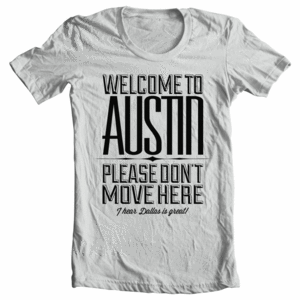
As we look at SXSW 2012 in the rearview mirror, these are just a few of our thoughts, takeaways and memories. We look forward to seeing an even bigger crowd next year. Until then, in the spirit of recapping the event that was, have a look at a t-shirt worn by many Austinites during the event this year (no offense to our colleagues in Dallas!)

What do Barack Obama, General Electric and Nordstrom Have in Common?

Bookmark and Share By Erika Briceno, Assistant Account Executive

…Pinterest!  Six months ago, my boyfriend referred to Pinterest as “the holy grail of social platforms for women;” however, it has quickly evolved into so much more.

Garnering more traffic than Twitter, YouTube and LinkedIn combined, Pinterest is fast becoming the leader in social sharing. Just recently, adding to the site’s 10 million+ users was Barack Obama.

Pinterest is no longer simply a site to plan future weddings or research new recipes, it has evolved into a digital space to ideate and inspire, while effectively positioning brands and products.

If your brand is on the fence about joining Pinterest, here are three main reasons as to why they should get on board and start pinning:
  1. Strike while the iron is hot - Pinterest users have increased by more than 145% since January of this year. At the rate this ‘invitation-only’ platform is growing, it could outpace some of the leading social media platforms in the near future.
  2. The scope of pinning has evolved - Pinterest is no longer a female-centric platform.  Male pinners are joining on a daily basis, totaling more than 20% of users. Due to their broad member demographic, it is an increasingly beneficial outlet for free digital marketing.
  3. Your competition is already pinning- Brands on Pinterest are receiving media attention for being innovators in the social sphere. Current top brands on Pinterest include Whole Foods, Michaels, Home Depot, Nordstrom and Martha Stewart, amongst others. Due to the high referral rates on Pinterest, competing brands are reaching a much larger audience than ever before.
Brands are not the only ones jumping on the Pinterest bandwagon. Publications, personalities, news outlets, bloggers and more have also taken note, including the Wall Street Journal, Time Magazine, Ellen DeGeneres, and Mashable.  This platform of discovery and exploration is helping brands and marketers drive traffic to their sites and tell their story.

In order to compete in the social sphere with Barack Obama, General Electric and Nordstrom; Facebook and Twitter presence will not be enough. You have to join Pinterest. Happy pinning!

Pay it Forward

Bookmark and Share  By Lori Martin, Vice President

Gotta make a change.  For once in my life.  It's gonna feel real good.  Gonna make a difference.  Gonna make it right. 

-Michael Jackson

Thankfully you’re reading this and not hearing me sing this at my desk. Most of us are energized by a music verse or tune we love. There’s something about this Michael Jackson song that gets me energized to pay it forward and try to do the right thing.

But, what energizes corporations to pay it forward and do the right thing? Certainly there is profitably as evidenced by goodpurpose® research. In America, 69 percent of people surveyed said they are more likely to buy products and services from a company if I know it has brands that support good causes.

Money is good. You can do a lot with it. But what about that priceless, invisible stamp that it leaves on your heart and in your mind? Doing good, feeling purposeful - as an individual, corporation or organization energizes people in an indescribable way.

We could all fill a book about simply “doing good,” so how about a real life example?

On Saturday, April 21, more than 1,800 local Comcast employees and their families and friends will volunteer to improve eight different locations throughout Greater Houston area as part of Comcast’s “Comcast Cares Day.”  At the same time across the country, more than 67,000 Comcast volunteers will participate in this annual day of service, which is one of the largest single days of corporate volunteer efforts in the country.

This is Comcast’s 11th national Comcast Cares Day.  Since its inception in 2001, Comcast employees, their families and friends have dedicated more than 2 million hours of service.  The company also has committed more than $10 million in grants to organizations nationwide.  Comcast Cares Day is one way that Comcast helps to power dreams and demonstrate a year-round commitment to making a difference in the communities it serves.

So, in case you need a little pick me up, might I recommend firing up your Comcast XFINITY internet connection and enjoy a tune from the moonwalker.

When it Comes to Healthcare, Who Can You Trust?

Bookmark and Share By Carolyn Mayo, General Manager, EVP

Healthcare Transparency & Trust
“A Forum with Houston’s Foremost Health Leaders”
 
Earlier this year at the World Economic Forum in Davos, Edelman unveiled findings from the 12th annual Edelman Trust Barometer.  Pairing data from the 2011 Edelman Health Barometer, we now know that health is a powerful trust driver and transparency is one of the keys.  Nearly 8 in 10 people trust a company more if it is effectively engaging in the health of the public in an open and authentic way.

Edelman will be examining the intersection of trust and transparency on April 25 with a forum of Houston’s foremost health leaders. Leading the discussion will be Nancy Turett, Edelman’s Global Health Chair.  She’ll be joined by a panel of Houston healthcare experts, including: Jim Langabeer, CEO of Greater Houston Healthconnect; Dr. Stephen Linder, Associate Professor at University of Texas School of Public Health, McGovern Center for Humanities and Ethics; Dr. Atul Varadhachary, President, U.S. Operations of Reliance Life Sciences. 

Transparency and trust leaves no one untouched – this session will apply to a myriad of health care sectors including: access, policy, providers, public health, research, and technology. Join us for a lively presentation and panel discussion on health-related opinions and behaviors to better understand what creates or eliminates transparency and trust in health care.   RSVP by April 19 to Crystal.Rivera@edelman.com or 713-970-2101.

Event Details:
Wednesday, April 25
7:30 - 9:00 a.m.
Registration, 7:30 a.m.
Breakfast and Presentation, 7:45 a.m.

Hotel ZaZa
5701 Main Street
Houston, TX 77005


Friday, March 9, 2012

Double Dawg DARE You!

Bookmark and Share By Helen Vollmer, President

I am a serious word wonk. Language is music to me. Want to make me happy? Introduce me to a new word or turn of phrase I’ve never heard of before. Which is why I am thrilled that after 50 years, the final volume (Volume 5) of the Dictionary of American Regional English (DARE) is seeing the light of day, thanks to Harvard University Press.

This amazing linguistic project traces how Americans speak and reflects how we’ve communicated past and present. The dictionary, with its 60,000 terms, also shows that while we have become mobile and many of us live far from our roots, some of our phrasing is “dyed in the wool,” proving that home is not necessarily where you live but what you take with you.

Cases in point:

Do you say “soda” or “pop” or do you simply ask for a Coke, like we do in Texas?

If you order a slushburger, you’re probably someone from the Dakotas who wants a sloppy joe.

If you’re from Wisconsin, you may want that burger with a wapatuli, a potent punch.

Will you vote for a snollygoster this election year? In the South, this is a term for a self-promoting politician.

The point of all this is that as life gets more homogenized and one WalMart pretty much looks like another as you traverse I-10 from sea to shining sea, the way we communicate and the words and phrases we use are details that make us distinctive and point to how we relate to the world around us. It’s how we tell stories about ourselves, serving up clues in word form.

In the days ahead, I DARE you to think about unique words clusters you use to engage with others. Oops—gotta run and clean up that Coke I just tumped over on my desk.

Picket Signs, Drums and SEO

Bookmark and Share By Rob Discher, Vice President

For what seems like the past six months, we’ve had a group of protestors waving picket signs and banging buckets outside our office every morning. They’re angry, it seems, about something. Or maybe they’re just interested in collecting the $10/hour they rack up for braving the frigid Austin winter outside the Omni building. Either way, they’re remarkably consistent. Come 8 am CT, the chants fire up, the drum sticks start connecting with the cheap plastic receptacles and the sings start bobbing up and down.

Here’s the problem – despite all the noise and commotion, I don’t think anyone in our office could tell you what these people are asking for? What are they so pissed about? What’s moving them to this point of action? What is their desired outcome?

I joked with someone in the elevator last week that these protestors needed a PR firm. I was only half kidding. We had both just walked past the blaring drums and shouts, coffee and laptops in hand. I asked my fellow elevator-mate if she knew what the protests were about. After months of walking past the picketers, neither of us had an answer.

What does this have to do with PR? Is Edelman breaking into the organized protest business? No, we’re not opening up a new practice group, but at a fundamental level, the argument about noise versus clarity is incredibly relevant.

Think of all the pitches, press releases, events, blog posts and speeches you’ve written over the past year for a client. Think of the last time you picked up a phone (I know, old school) and called a reporter.

…or pitched a blogger on an event you wanted them to attend;

…or hit up a third party to sign an op-ed.

How central was that action to what your client really wants to be known for? I say this as someone who has spent years chasing down client deliverables assigned on a whim, some of them well thought through, most of them well-intentioned, but not all of them with logical ties back to our initial mandate.

This is why I’m excited about SEO and why at some level, it’s relevant to every piece of work that comes through our doors.

First, a little background. One of my college economics professors hammered us on the concept that economics was more a model for looking at life than a way to dissect FED rates and fiscal policy. We were encouraged to use concepts like opportunity cost and sunk cost to weigh decisions in everyday life. When do you consider something “done” and move on? What do specific actions…specific uses of your time…REALLY cost you? Where else could those resources have gone? The older I get, the more the economics mindset makes sense.

Search Engine Optimization has a similar potential. Right now, most people look at SEO in terms of linguistics, as copy on a web page or an inbound links strategy. The full potential for SEO goes well beyond that tactical approach, and it’s a lesson our friendly protestors with their lack of message clarity could use next time they hit the corner of Brazos and 8th.

SEO is rooted in the ability to discover what a company really wants to be known for and where its competitive advantage sits. You start the SEO journey by landing on a set of keywords… short and long tail phrases that the company stands behind…and you build the campaign around them. You pull together paid and organic search strategies, and you begin to see all the places that these key terms should be living – places that previously were the domain of a scattered strategic exercise or a one-off campaign.

What started as a site linguistics exercise now impacts the press releases you’re sending out. The content for the blog you help write for a CEO comes not from his late night rambling emails but from an intentional set of concepts you’re working to build the company’s reputation around. Pitches to reporters and bloggers are influenced by the topics you’re looking to drive traffic around and the credibility your site gains via the “vote” you get from that outlet writing about you.

These campaigns are more effective, more measurable and better aligned with business objectives….yes…but more simply, these campaigns based around a strong keyword strategy, founded in SEO best practices, are clearer. They’re cleaner. They’re better defined. They’re the equivalent of the well-spoken friend in an elevator calmly and simply explaining a situation, contrasted by the screaming protestor whose messages and tactics send you in a thousand different mental directions.

It’s time we start thinking a bit differently about SEO...and maybe about our picket line strategy.